Have you ever wondered why or how content like the Old Spice ad or Gangnam Style music video went viral?
The 6 STEPPS Principle
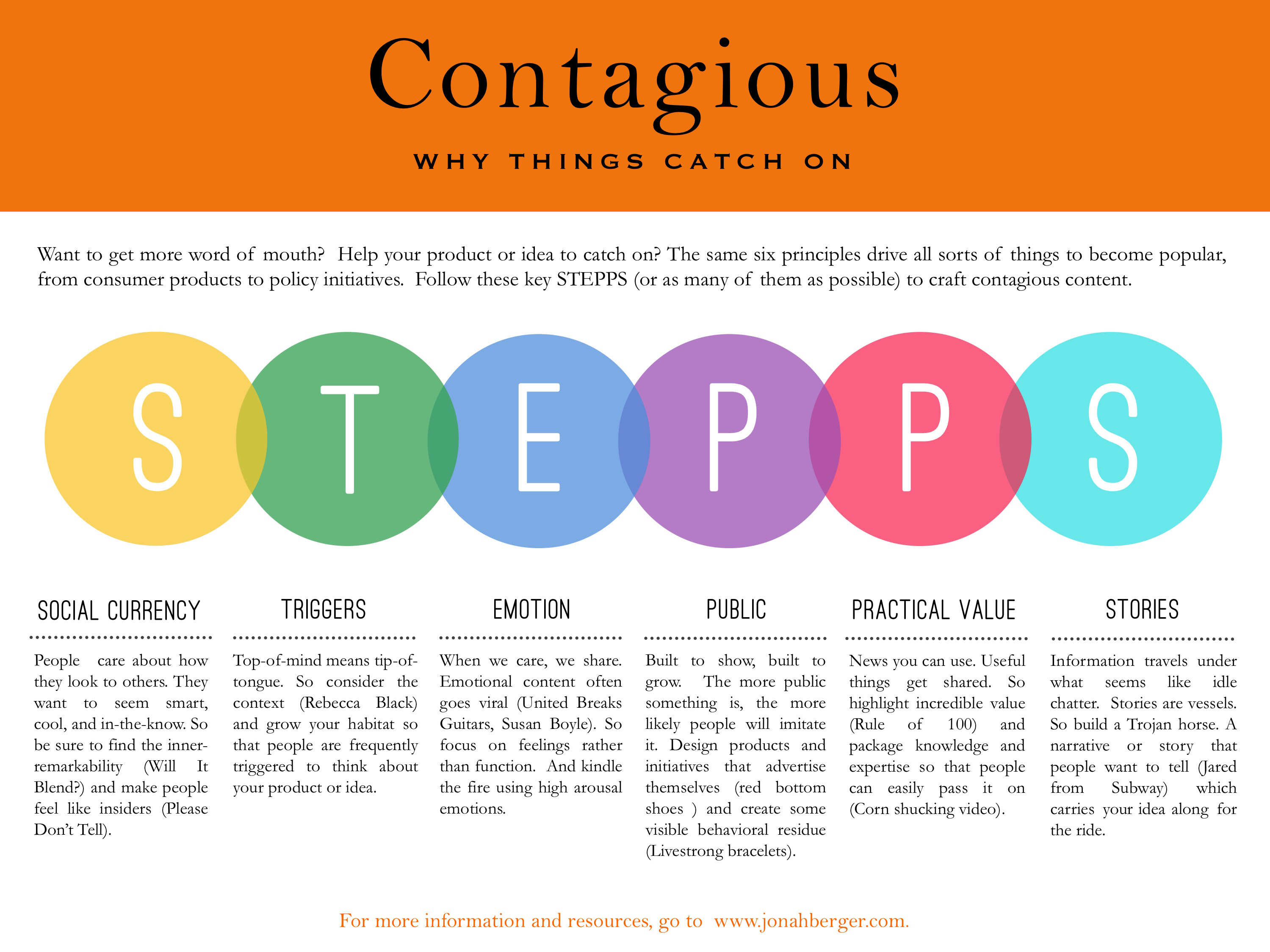
Jonah Berger, an expert in word of mouth and viral marketing has identified 6 STEPPS to a successful viral marketing in his book Contagious: Why Things Catch On.
How did THIS went viral?!
Now.. let’s look at this video hoax of a marketing campaign for Holiday Mooloolaba that went viral!
One might wonder, how did THIS spread?!
According to Berger’s 6 STEPPS, this video fits the principles of Emotions, Public and Stories. And how so?
In the video, the girl Natalie tells the story of how she met the man of her dream and later lost contact with him but only to find out that she is pregnant 6 weeks later! This “story” was newsworthy to the media outlets as it hits home emotionally and made people sympathise with her. Not only that, the video’s youtube URL was shared on various Facebook community page making it “Public” and easily shared. In a bid to help Natalie find the man, people shared the video leading to its virality!
Campaigns such as the Holiday Mooloolaba video may gain virality, but the public backlash should be taken into consideration. Afterall, is the negative public opinion worth it for the brand as consumers felt cheated?
What about.. The Three Rules?
Berger’s 6 STEPPS definitely highlight how marketers can make it easier for ideas or content to spread. However, in my opinion, there are other factors that marketers should keep in mind when producing a campaign.
In the book The Tipping Point: How Little Things Can Make a Big Difference, author Malcolm Gladwell discussed how the Three Rules of Epidemics help to spread ideas like wildfire.

Berger’s theory suggests how we can create content that spreads whereas Gladwell’s theory focus more on the environment required for ideas to spread.
For instance, the Law of the Few in Gladwell’s theory, whereby word of mouth through Connectors, Mavens or Salesmen is required for ideas to spread. This is definitely necessary, and in the Holiday Mooloolaba viral video, the news outlet acted as a “connector” to the audiences.
Conclusion
As marketers, both theories from Berger and Gladwell should be considered when we are coming up with ideas for our content. Berger’s theory help us to create content that are relevant to the audience while Gladwell’s theory help us consider the optimal environment for our ideas to spread.
Is there a theory you prefer? Share your comments below!


 Jamie's Blog
Hi Jamie, its a great blog post illustrating both theories from Berger and Gladwell about how some ideas can spread like a wildfire! I agree with you that both theories form Berger and Gladwell must be considered all together as this can allow a potential viral marketing campaign to be even more successful with more aspect being look into.
Looking at the example provided in your blog about the Holiday Mooloolaba that went viral even though it was just a hoax, it was able to attract a huge pool of audience. The video content was something that people find interesting, something that provides them with social currency when they share it on their social media as it was a hot topic. At the same time based on Gladwell The Stickiness Effect, people want to know whether she can find the love of her life which was a characteristic that kept the message going on. This therefore shows that both theories apply together to make things work well!
Do check out my blog and leave some comments too!!
LikeLike
Hi Ying Han, thank you for your comment! I agree that both theories can be applied to together to make content go viral. The virality of the Holiday Mooloolaba video has definitely resulted in more shares due to social currency. On top of that, Gladwell’s stickiness effect also helped spreading it like wildfire! A pity it received backlash from the public otherwise it would have been such a great campaign if done in a tasteful manner.
LikeLike
I’d think both theories work hand in hand together. However, I believe it is not easy for a content/ video to have all the elements (6 + 3 rules). Ultimately, marketers need to know what is the feeling he/ she wants to evoke in the consumers and subsequently, create context based on that. Understanding the environment and the consumers is an essential step for all marketers.
LikeLike
Hi CNCJ, thank you for sharing your views with me. I agree that it is difficult to cover all 9 elements in our content. This means that marketers have to decide which elements is most important to have, and which is the most applicable. The selected elements must also work hand in hand to produce quality content. As you have mentioned, I agree that emotions is one of the more effective element that should be taken into consideration.. like what Berger says, “When we care, we share”!
LikeLike
Hi, nice description you got on both theories! Personally i would feel that Berger theory would be my preference as it showcases different ‘stepps’ in order to achieve that and i can relate better with it. Using the theory such as story. We can talk about for instances gravity payment when a minimum wage of $70,000 is give to all employees. Now this is a story to tell and thats why the brand spreaded out to the world at an alarming rate in which benefited them. This shows the 6 stepps theory in my view is more preferred as it broaden the scope of spreading ideas and content across the globe.
LikeLike
Hi Pei Yuan, thank you for sharing with me! Interesting to note that you preferred the Berger’s 6 STEPPS principle. Although I feel that there was probably the stickiness factor in Gravity Payment’s story, I agree that the 6 STEPPS principles is sufficient to explain why their company’s equal wage story went viral. Principles such as Triggers and Emotions, as people feel envy or surprised of the high salary and equal wage culture, and it is definitely a “story” that people wants to share about, thus the social currency principle applies.
LikeLike
Good explanation of the different theories. I will prefer Berger’s as I believe that the content is important to attract viewers, which will eventually trigger all factors that allow people to spread through word of mouth.
LikeLike
Hi Natalie, thank you for sharing with me. I agree with you that content is important to trigger emotions and action in consumers. I too find that Berger’s theory is more comprehensive and much easier for marketers to apply the factors to include in our content. However, I believe we can make use of and combine both theories to stand a higher chance of an idea catching on. Imagine applying the 6 STEPPS with law of the few or stickiness factor, I think the idea will start spreading like wildfires! I guess the difficult part about the 6 STEPPS is getting to understand what sort of content will triggers, affects or is of value to the consumers.
LikeLike